
Within the first 24 hours of taking your baby home, every new parent asks themselves “kitni baar aur kitna feed karna hai? Feeding breastmilk to a newborn is like having a full-time job in a sense, it is. With the 2 a.m. awakening and the ongoing trial-and-error process, it’s easy to get questions about whether you’re doing it right.
This post explains exactly how often newborns are eating and how much breast milk your baby requires at each feeding stage and how to establish a feeding schedule that works for your family when breastfeeding. The good news is that while each baby is unique, there is a general guideline for how often to feed a newborn baby and with knowledge of this, feeding can be a lot less stressful.
From birth to 3 months, this guide addresses every scenario from hours between feeds to ounces to “why do you want to feed me so much now? Save it for later you will be referring to it several times in the next few weeks.
What Is a Normal Feeding Pattern for Newborn?
Newborn babies don’t run on a clock that’s normal. Baby feeding on demand is recommended for the first few weeks rather than a feeding schedule. On-demand feeding refers to feeding your baby when he or she expresses feeding cues rather than at a scheduled time.
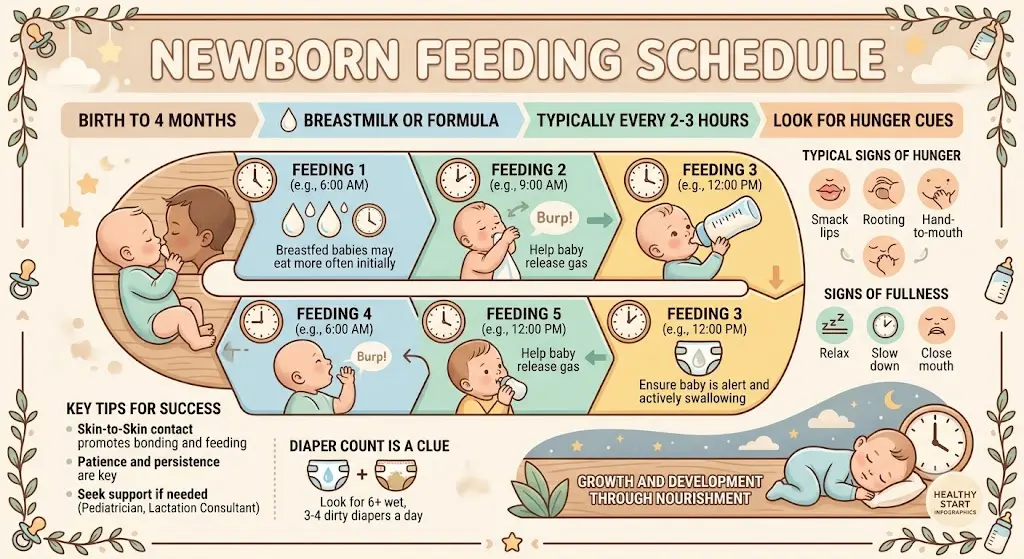
Hunger cues come first, before the crying starts. Early cues may include turning towards the breast (rooting), hand sucking and increased alertness. Crying is, in fact, the last hunger cue. Early identification of hunger cues will ensure that you both stay calm during the feeding process.
Later feeding is more successful: after the 1st month when milk supply is established and baby is self-regulating (usually). Until then, establishing a good feeding pattern early, following your baby’s lead will help with healthy weight gain.
How Often Do Newborns Eat?
The thing that surprises most first-time parents is how often babies feed. The American Academy of Pediatrics states that for the first 24 hours, your baby needs to be fed about eight to twelve times and that is equivalent to feeding every two to three hours. It should be noted that feeding breastmilk is very easily digestible
Cluster feeding can upset this routine, typically in the evening. A cluster feed involves your baby feeding almost continuously for several hours usually in growth spurts around 2 to 3 weeks, 6 weeks and 3 months. It’s tiring but is a mechanism your baby uses to help increase your milk supply before a growth spurt.
The night-time feedings are not the same as the daytime ones. Newborns eat much during the night as well as the day as their stomachs are small and cannot contain a lot of milk at a time. Many babies begin to connect a few longer nights together around 6 to 8 weeks of age, although that can be quite different for each baby.
Growth spurts do not occur on a specific schedule but do fit into predictable periods. Most babies have signs of sudden spurts at 7 to 10 days, 2 to 3 weeks, 6 weeks and at 3 months. These periods may result in your baby feeding more often for 2 to 3 days and then going back to their usual feeding schedule. If you know that a growth spurt is a normal part of life and not an indication of low supply, you’ll save a lot of unnecessary worry.
Infant Feeding Schedule by Age
A newborn feeding schedule is dynamic for the first 3 months, as your baby’s tummy gets bigger and more efficient. So, what does each stage entail?
First Week Feeding Schedule
The baby’s stomach is small, about 5 to 7ml (like a cherry) on day one that is why baby takes small portions frequently. Stomach capacity increases to 22 to 27 ml on day three and to 45 to 60ml on day seven. Feeding is frequent at eight to twelve times daily, twenty to forty-five minutes each time.
1 Month Feeding Schedule
Most babies will be feeding breastmilk 7 to 9 times a day by 1 month and their stomach capacity will increase to about 80 to 150ml per feed. Feeds also become more efficient and can frequently be completed in 10 to 20 minutes per feed.
How Often Should a 3 Month Old Feed?
One of the common questions that parents ask is “how often should a three month old feed?” The truth is that three month olds are not eating as much as a newborn but they are eating more per feeding. Most babies will have around 6 to 8 feeds in a 24 hour period at 3 months as they have a stomach capacity of approximately 150 to 180ml and are much more efficient at getting milk from the breast.
2-Month Feeding Schedule
The 2-month mark is when babies feed 7 to 8 times per day, starting to sleep for longer periods at night.At 2 months, babies sleep longer at night and feed 7 to 8 times a day. This may increase around 6 weeks of age, by a few days of cluster feeding before declining. Interested in feeding after this age? See the bottom of the FAQ for information on how many feeds a 2-month old requires.
How Much Breastmilk Should a Newborn Eat?
As well as timing, ounces are important when it comes to feeding breastmilk with confidently. The stomach is so small that in the first few days babies only eat 1 to 2 teaspoons (5 to 10ml) per feed. By day 10, that grows to about 60-90 ml (2 to 3 ounces) per feed.
The babies will be expected to take between 2 and 3 ounces during each infant feeding schedule with a total of 25 to 35 ounces on daily basis up to one month from birth. The amount taken during feeding will increase to 4 to 5 ounces from two to three months. However, the total amount of breastmilk taken by the baby will remain constant because of the varying contents of breast milk.
These numbers are approximate, not a rule book and change for premature babies, twins and babies with reflux. All babies take their time and some will cluster feeds (feed more at any one time) whilst others will prefer to feed more frequently but with less food. The daily trend, not necessarily any one particular feed is what is most important.
The best indicators that your baby is getting enough are that he is pooping 6 or more times a day after day 5 and is steadily gaining weight 150 to 200 grams a week for the first 3 months. The reassurance checklist is completed with regular bowel movements and an overall happy baby who is not fed.
Tips for Establishing a Comfortable Feeding Routine
It’s more effective to feed when your baby is hungry, rather than following a set schedule, particularly during the first few weeks. However, do not let a newborn baby go more than say 4 hours without food not even at night until he or she has gained some weight.
Following up on feeding pattern for newborn for the first couple of weeks will help you identify patterns and will help you discover issues early. A log book or a feeding app will do just record the time, length of feeding and side. Then look for patterns without obsessing over each and every minute.
Involve another person, be it partner or support person, as far as possible. Pumped milk allows you to get more sleep than you would with an unhelpful baby and it’s just a simple matter of having another set of hands on hand to help with a night feed.
If your baby eats less than 8 times per day, fewer than 6 diapers after day 5 or is never satisfied after prolonged feeds, contact your pediatrician. From Daily Care Insights will advise you to always listen to your instincts, as you know your baby best.
Conclusion
At first feeding breastmilk a newborn seems a daunting task but it is more routine than it appears. In just a few days or possibly after a week or two, you and your baby would have established the routine of feeding which should be done around 8 to 12 times a day. Be sure to monitor their wet diapers, their weight and other signs that show their hunger. If you have questions, don’t hesitate to approach your pediatrician. Daily Care Insights will guide you along with scientifically backed advice from birth up to toddler age.
FAQs
How long has to be the duration of the newborns’ breastfeed?
The majority of feeding breastmilk for newborns take 20 to 45 minutes until your baby learns to breastfeed successfully. This usually reduces to 10 to 20 minutes when feeding with breastmilk is further established after the first few weeks.
How long to breastfeed?
According to the World Health Organization’s guidelines for breastfeeding, it is recommended that infants be breastfed exclusively for six months, followed by supplementation with solid food and fluid for up to two years or even longer. It is entirely your choice.
What is the right amount of breast milk for a newborn baby?
During the first two weeks, babies will take 1 to 3 ounces of breast milk during each feeding session. At the one-month mark, the quantity of feed will rise to about 3 to 4 ounces.
How long do I need to spend feeding my baby?
Don’t feed by the clock, if your baby’s body is relaxed her hands are open and she is turning her head to the side when she senses it is time, it is time. Most sessions are 20 to 45 minutes in the early weeks and gradually get shorter as nursing becomes more efficient.
How many times should a 2 month old feed?
A 2-month-old infant is expected to consume 7 to 8 times daily with some “cluster feeding” during growth spurts. They are starting to get their tummy size increased as they grow apart.